To find out from whom I came, I must travel to Portugal. Ironically, the best records of Conversos are kept by Roman Catholic parishes. Records likely go back hundreds of years -- back to the start of the Inquisition (1497), or to the year the parish was founded, perhaps as far back as the beginning of the Millenium.
If you want a sense of how meticulous Lusos (people of Portuguese heritage) can be when it comes to documenting death and torture, watch the movie Brazil.
[Paradise by Lucas Cranach der Ältere, oil on wood, Wikicommons]
Complications Ensue...
Most of my family, myself included, don't have birth certificates. My only record of "coming into existence" is my baptismal record, or cedula (which doesn't have a picture). The cedula records birth, comfirmation, marriage, and other sacramental rights. The parish also kept records of "good behavior" & financial contributions. And course, records of heretics, and their "outcome."
But, until I can get grant money for travel, I must rely on Library & Web research; exploration of every clue, however far-fetched; lots of Imagination; and Conspiracy-Theory-type thinking.
Confirmation BIAS alert, ie, even though I want to believe my immediate ancestors' surnames are definitive clues, they are about as reliable as hearsay, however juicy my "facts" may be. Pre-Modern people made up & discarded surnames at will, and often village folk re-named their neighbors. Descriptive names might stick to a man, and remained glued, like it or not, to the next generation. Imagine a world where nicknames given by siblings, fraternity brothers, the town joker, and/or gossips have a half-life.
My maternal grandfather, Francisco Pinto, for example, loathed one of his paternal surnames: Alpiarca. It was the name of the village in central Portugal from where his grandfather migrated. When he was nine or so years of age, Francisco Pinto managed to officially eliminate the Alpiarca name from his line of descent. My people are precocious. He wasn't the only anti-Alpiarca campaigner; many kinsmen tried to wipe the name from history. Of course, that/those stories are for another post. And of course, the name survives (in Massachusetts, btw).
A man and/or woman could try to assert control over their destiny and/or re-create their heritage by adopting the name(s) of persons they aspired to be. Or take the socially-respected, Inquisition-Evading names of the local gentry. A powerful patron could be named as a child's godparent, and the godparent's name (and some privileges) would be given to the child.
A great source is Jeffrey S. Malka, author of Sephardic Genealogy: Second Edition, Discovering Your Sephardic Ancestors and Their World. [More commentary from Malka in future posts]
To briefly sum up: When forced to convert, Sephardic Portuguese chose new surnames that were "close to the earth."
Who, What & Where in the World are my Maternal Surnames?
My mother's natal village contained many wild plants/trees, as well as cultivated orchards & crops. "We had so many trees on the finca (estate)," said my grandmother, Maria do Rosario Bispo Carvalho (abridged name). "It was as if I lived in the Garden of Eden."
Commonly, when Jews were baptized, they re-created themselves by selecting names of trees, eg, Carvalho (Oak), Oliveira (Olive tree), Pereira (Pear tree), Pinheiro (Pine). Less common: fruit, eg, Sousa (type of Sherry grape near the Douro River); or animals, eg, Coelho (rabbit), as in Tony Coelho, former congressman, and Pinto (type of horse), which happens to be my grandfather's name.
RE: Culture & Greatest Stories Ever Told. Expect humor/irony. If you don't like controversy & honest, non-dogmatic prose, move on -- this blog's not for you.
A funny thing happened on the way to the Revolution...
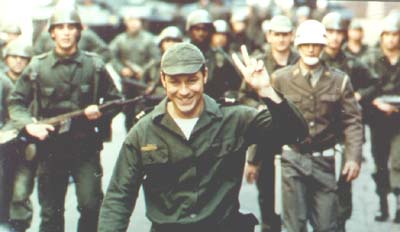
I must say, as revolutions go, the Portuguese "Armed Forces Movement" of 1974 was awesome. And I'm not bragging simply bcz my people rock. The universal forces of history & mathematics back me up. KEY STATISTIC: Number of people killed by revolutionaries: ZERO.
Not one person. You've heard of "bloodless" coups. Well, this uprising came miraculously close. A few people were killed, but not by the military. Members of the secret police, the PIDE, fired into the unarmed crowd. But that shouldn't count-- because the PIDE were always killing people.
Watch the movie: Captains of April. Portuguese w/ English subtitles, available thru Netflix. The love story is weak, as love stories so often are when wedged into epic tales of war, but the rest of the film shines. Produced by Maria Medeiros, who you may remember from PULP FICTION, but more important, she sort of looks like me.
Medeiros totally captures the charisma of the revolutionaries, the mood of the times, and how seriously funny the whole thing turned out to be.
FUNNY? First, tanks stopped at traffic lights. I kid you not. I asked my dad about this. "What the hell kind of revolutionaries stop at traffic lights?" I said.
Jeronimo Vazao was in the military, and served in the same barracks (Caldas da Rainha) as did the Hero of the Film (although at different times). My father's Army class was the last to serve on the mainland; all subsequent enlistments were sent to Africa to fight in the colonial war.
Without looking up from his newspaper, my father answers, "Certainly, the officers stopped at traffic lights. As it should be. Order and discipline." Finally, he puts the paper down. "It was a matter of public safety. You have to respect the laws."
MORE FUNNY: Shortly before some Captains of April were scheduled to take over the government radio station, they locked themselves out of their car. At the time, they were parked, unbeknownst to them, in the most notorious homosexual meeting place in Lisbon. And the young men have to change into their uniforms inside the car. Well.... funniness ensues.
For my info re: My family & the Portuguese Revolution, SEE: Flying to America: Revolution & its Discontents
Not one person. You've heard of "bloodless" coups. Well, this uprising came miraculously close. A few people were killed, but not by the military. Members of the secret police, the PIDE, fired into the unarmed crowd. But that shouldn't count-- because the PIDE were always killing people.
Watch the movie: Captains of April. Portuguese w/ English subtitles, available thru Netflix. The love story is weak, as love stories so often are when wedged into epic tales of war, but the rest of the film shines. Produced by Maria Medeiros, who you may remember from PULP FICTION, but more important, she sort of looks like me.
Medeiros totally captures the charisma of the revolutionaries, the mood of the times, and how seriously funny the whole thing turned out to be.
FUNNY? First, tanks stopped at traffic lights. I kid you not. I asked my dad about this. "What the hell kind of revolutionaries stop at traffic lights?" I said.
Jeronimo Vazao was in the military, and served in the same barracks (Caldas da Rainha) as did the Hero of the Film (although at different times). My father's Army class was the last to serve on the mainland; all subsequent enlistments were sent to Africa to fight in the colonial war.
Without looking up from his newspaper, my father answers, "Certainly, the officers stopped at traffic lights. As it should be. Order and discipline." Finally, he puts the paper down. "It was a matter of public safety. You have to respect the laws."
MORE FUNNY: Shortly before some Captains of April were scheduled to take over the government radio station, they locked themselves out of their car. At the time, they were parked, unbeknownst to them, in the most notorious homosexual meeting place in Lisbon. And the young men have to change into their uniforms inside the car. Well.... funniness ensues.
For my info re: My family & the Portuguese Revolution, SEE: Flying to America: Revolution & its Discontents
Subscribe to:
Posts (Atom)