#GetReal Top 100 Reading List (ATTRACTIVE BOOKS)
Buttercup, Fill Me Up

"People empty me. I have to get away often to refill." -- Charles Bukowski
"Is this not the autobiography of every great writer," I respond.
But, in their response, other writers post: surely not so of extroverts. Among them, there must be a writer or two, though admittedly few.
To which I say, from my cloister: I'm an extrovert -- not by much, but, yes, nonetheless. I get energy from people. I need to scale life's mountains in my mind and with my hands. And, YES, people empty me. SOMETHING FIERCE.
We are so different from each other and must use each other to get what we want, which is not necessarily a bad thing. It just is so.
To clarify, I'm a writer-writer, specifically, a highly-reflective person who over-thinks everything except the golden things that I think just right about. And as a writer-writer, I am so different from "normals," especially from "normals" in a country as anti-intellectual as America.
I outlie. You must remove me from preconceived notions, logic, and analysis, or I'll junk your data. I'm a guest everywhere at anytime. You won't find me Home, where ever that might be. And I do keep looking. I'll never stop looking even though I know the truth.
This EXHAUSTS ME.
To me, people can't see "the obvious." Because it's not really. I've been thinking about It for so long. Then, I go for a walk. And set upon a moment when the bathtub of my head overflows onto your bathroom floor and you hurl apples at me.
People don't understand why I must stop and listen to the gray-black bird in the linden tree on my way to work to find out who she is even though I'm far too late. But I'll remember her longer than I might the fleetingly mighty man by my desk.
Folk don't hear the meter and the rhyme in things far and wide so loud at times that their elevator stops. And the chimes stop, but their box don't stop moving. And you're between the thirteen floors. And you twist and turn. But they're moving up. So they look at you. As though. You've got a gun.
Aldina! Aldina! The Meaning of Me

My mother tells this story: When I was baptized in Portugal, the priest asked my name. As Mother prepared to say "Susana," my godfather blurted "Aldina." No one in the hamlet --neigh the parish-- had heard such a name.
It was the custom among some for godparents to bestow their name, their blessing, & their patronage on the child. "It's a fine name," said my padrinho Joaquim Almeida by way of explanation. "I made it myself. What better gift could I give than that?"
In Fellini's semi-autobiographical film, Amarcord, characters shout my name during a peak moment, & I have since learned "Aldina" is Italian & Turkish. I traced a variant of my last name to 14th century registries in places of worship in Apulia on Italy's Adriatic coast & in Thessaloniki on the Aegean Sea.
On an impromptu voyage of discovery a few years back, I traveled to America's oldest synagogue & met a gentleman from Morocco. I hadn't set out to visit Philadelphia -- it was simply the last train out of Penn Station. But there I was, near a Sephardic synagogue. And it was Saturday.
I asked, could I come inside, once I found some proper clothes. It was Memorial weekend & it was hot. I wore a little black dress, the same one I'd worn the day before; I hadn't packed for my trip. I ran to the nearest drug store & found tights & a plastic poncho that looked like a judge's robe.
Earlier that day, I'd walked around North Philly & discovered in a dollar store a hot pink paper hat,

And there I began to unearth the strange Sephardic roots of my family that spread to my godfather, who blessed me with my name -- the name of Jacob's spurned tribe, which sprang from Leah's seed, whose words remain unknown.
The World is Not Enough with Me [sonnet]

As a kid, I played
At Mass. I was the Priest.
I gave my sister Communion
In our plastic-draped, pastel living-
Room in our one-bedroom home
In our barrio in ritzy Westchester
In New York. We weren't allowed
In the living-room. But in
For penny -- in for pound.
We broke sugar cookie hosts.
We have no pictures;
We didn't document sins.
If I led down the aisle,
Would you convert?
Series: Watch a Poem Grow: Make a Noise
A family of trees fall. Slugs
We leave. Snails, we keep. Watch
How shells repel the black stream.
See how feelers smell and retract,
Snap and grow. Regrow. Snap.

The PROCESS:
This poem was based on lyrics from MGMT's Kids. [See: Who is MGMT -- Watch Video ]
For days, the lyric segment, "take only what you need" kept haunting me. Seriously, it would repeat for hours, finally be sent packing by a major distraction, and return during any boring/routine activity. I did not like the message, therefore, Kill the messenger.
At a previously-scheduled retreat, during the inevitable collage-making activity, I cut thru a Forbes magazine & tried to pin down lyrical meaning.
When I returned, my son told me what he remembered of lyrics's chorus: Enjoy yourself// Take only what you need from him// A family of trees fallin// To be haunted.
OK, well that changes things. To be one of the title's "kids" is to enjoy yourself, and take only what you need might apply to a journey, as in when packing take only what you need -- a liberating message, no?
But... the mood of video -- where rotting monsters follow a crying toddler who walks away from an inattentive mother & heads to the forest -- that didn't connect.
So, I printed out true lyrics. It's really. CONTROL YOURSELF // Take only what you need from IT. // A family of trees wantin' // To be haunted.
Yeah. It was Poetry Time.
I did word analysis, breaking down lyrics (both real and misheard) into word groups: verbs, pronouns, nouns. Separately, I matched/generated sound alike words & pulled together full rhymes and slant rhymes, which are internal rhymes, which I use extensively.
Then, time to write. I started a haiku, which is three lines: 5, then 7, then 5 words each. This helped me simmer poem down to core. Haiku has two ideas or images; includes seasonal reference; and uses the "knife" -- a word that slices parts of poem into two images or ideas, with the "knife" word as bridge uniting the two components.
I like to brainstorm a Haiku, because, ha ha, it cuts poem to its core. Forces a setting or mood because of the need for seasonal reference. Forces turning points. Encourages concrete word usage and economic use of symbols.
From my haiku skeleton, I played around with words & symbols & double entendre, added what felt left out and voila, my draft of Make a noise.
So, I'll put it away for a months or so, and then start the long, long editing process.
Inquisition Records: Thick with Family

[Illustration, wikicommons: Francisco de Goya, Inquisition Tribunal]
CLICK TO SEE: LIST OF NAMES -- PORTUGUESE INQUISITION RECORDS
From: LES NOMS DE FAMILLE DES ARCHIVES DE RECHERCHE DU PORTUGAL « TORRE FONT TOMBE Du livre édité par Flavio Mendes Carvalho ***
Family Surnames that I discovered:
ALMEIDA: Surname for my uncle (husband of my father's sister) and my godfather, Joaquim, who named me "Aldina," a Sephardic/Turkish name. The Almeidas held land in Pedreiras, my paternal parish. Their property was adjacent to or near one of Vazao and/or Sousa land holdings. Likely, the Almeidas are distant blood relatives of mine.
BTW, Almeida is also the name of a town in North-West Portugal -- important militarily because the once-fortified town was near a road connecting Portugal and Spain. Theoretically, if you were trying to escape from the Spanish Inquisition, Almeida might be a good place to cross into Portugal.
BISPO: Great-great grandmother's surname. The women on my mothers' side are referred to as "Bispas." Original Matriarch had 11 surviving children and ran regional trading business; the eldest daughter was my great-grandmother Maria, who had only one surviving child, my grandmother, Maria do Rosario CARVALHO.
***CARVALHO: Common name in native region of my maternal family. Oak forests predominated at time of town's founding; Carvalho is oak in Portuguese. Carvalho is surname of my maternal grandmother. The name Carvalho passed to my mother's two sisters but not to my mother.
According to my mother, her father Francisco didn't like the name Carvalho because just about everybody in the parish was named Carvalho. So when he registered my mother with the town clerk, Francisco dropped the name Carvalho and replaced it with "do Rosario," i.e., of the Rosary, which was my maternal grandmother's middle name. Subsequently, the authorities became more rigid about names, and Francisco had to register his two younger daughters under their mother's surname, Carvalho.

HENRIGUES: Henriques, surname of Maternal relatives; my mom & her cousin share same great-grandparents.
MATTOS: variation of surname of maternal cousin who emigrated to Brazil, and then to NY. Matos means woods. Mata connotes thicket, wild forest, jungle. And, mata is the imperative of "to kill" -- mata-os means Kill Them.
PINTO: Paternal Grandfather. He kept the Pinto name, and was known about town as "Francisco Pinto." Nonetheless, he tried to "upgrade" our identity by taking advantage of bureaucratic chaos and registering as Morgado, which was the surname of the region's original gentry. "Morgado" passed to my mother, but local authorities prevented my grandfather from "upgrading" names of his younger daughters. While Pinto is on the Inquisition rolls, Morgado is not. The Pinto name did not pass to me, but Morgado did.
SIMAO: variation of surname of maternal relatives, and of my mother's godmother & mentor, and of my sister's godfather.
SOUZA: Spanish version of Portuguese SOUSA. Surname of my paternal grandmother, and one of my father's surnames.
VAZ: variation, perhaps original version, of my surname Vazao. Vazao could mean "The Big Vaz." There is an area in Portugal called "Vale de Vazao."
XAVIER: Surname of mother's second cousin
** Translation of French original: "Si votre nom de famille est énuméré ici je peux fournir des données quant a ce qui leur est arrive. Ils furent : Brûlés vifs, garrotés et brulés, esclavage d'office, emprisonnement perpétuel, tortures."
PHOTO courtesy of Clara Castelar, saudades.org
Interplanet Hope

What if God were a planet—
In a white-hot, violet galaxy?
Perhaps if God were a planet
We'd relocate. We'd get new homes,
New pets, and shiny new clothes.
What if galaxies were God—
All of them? Might we evaporate
Into Divinity when we die?
Our ashy bodies compost, we know.
Even if, somewhere, we keep copies.
We'll leave molecules in tomatoes,
Wells, wool, sweat, and waffle cones.
On Earth, finally, we'd be everything.
Though what is the what, we won't know.
Somewhere, we do penance. Spit? Smoke?
Cast away? Lost in the belly of the Globe?
Demons who once breathed—
Who sold certificates for Heaven—
Who drank from jeweled grails—
Move to the Inner Circle.
[first draft of part 1]

So Who (Whos?) Wrote the Bible?

Everybody says Moses wrote the Torah, which includes Genesis & Exodus, the BIG Bang B.C. books. But, as usual, Everybody is wrong. Not least because Moses DIES.
According to the Documentary Hypothesis, there are basically four biblical editorial academies. Imagine: the bible was written by committees of committees. If you've ever tried to pull off a big project by "consensus," you'll appreciate that the finished product took a really, really long time.
Now for the Alphabet Lesson:
The J (German acronym for Y - YWHW) refers to God as YHWH (which is supposed to be unpronounceable, and hence never spoken aloud). Super-strict Jews generally say Hashem instead.
I've been told to avoid using "Yahweh" in poems intended for a Jewish audience, which is kinda ironic because I thought Yahweh would connect all through a common belief in the Old Testament. So, in my attempt to reach out to Jews @ Yeshiva, I almost insulted them. Sigh. Inter-faithing is fraught with challenge. Oy.
The “J” school probably lived around Jerusalem, and hob-nobbed with the Court elite. Harold Bloom even speculated that J was a woman living in Soloman's court, given J's highly refined & literary-text-savvy writing style. At first I thought: NO WAY a woman would write the second Genesis story!! By after thinking about it, given how progressive the Hebrews were, relative to contemporary tribes, a woman's lib's reading make sense. [But that's for another post.]
The “E” school refers to God as Elohim and likely was from Northern Israel. E is nowhere near as big a deal as J.
“D” is for "the Deuteronomy writer." Guess what they wrote? BTW there are more curses in Deutero than in most rap songs. For Real. Check it out.
The “P” or Priestly writer loved loved loved lists, regulations, and lots of historical-seeming facts. All those genealogies you skip over? Brought to you by P.
A super-anal canon lawyer is sure to test the patience of a lay audience. Such painfully excessive detail especially annoys me because it's mostly made up/arbitrary; the more precise the detail, the more likely it's factually false.
But the point is not historical accuracy. It's about discipline. The priests standardized worship and religious practice in order to create cultural cohesion. And it worked.
As a fiction writer, I have a special angry spot in my heart for people who tell me how pointless fiction is, and how morally superior "facts" are compared to fictional/dramatized stories. You know, those people who only read "non-fiction" or journalism, in order to seek The Truth. People like my Dad.
"I don't waste my time reading things that aren't true," my father told me when I was a kid. He was referring to literature. Sigh. Well, I won't be dedicating my first novel to you, Dad.
Of course, Daddy and his ilk read the newspaper, and watch TV newscasts and documentaries. You know, "real news." Presumably, the Bible is True, and therefore it's not literature, which isn't "true."
The P-Priestly writer probably penned Gen 1, and J probably created Genesis 2.
Clearly, the J writers are the Lyrical Masters. It should be obvious J is telling stories: Myths, fables, historical novellas (like Joseph's tale) are based very loosely, if at all, on real people and real events. But apparently, nothing is obvious.
The Genesis stories were transmitted orally, and as oral stories are wont to do, mutated from generation to generation, but with common motifs. The Final editors (compiling in Babylon?) didn't know which version was more correct, so they included all of it.
The idea was that scholars would read the complete text and argue among themselves as to how to interpret the stories, conflicts and all. Hence the importance of studying Torah, and the social esteem of the Rabbi. The Scriptures were tough, and required a lifetime of study.
Personally, I'm don't mind that both stories are included. Consider: factual problems in the bible are a SIGN of QUALITY REPORTING. They collected all the available evidence.
The More Sources the Better:
journalist's take on Genesis

Genesis has always vexed me. I'm simply mystified that the Adam's Rib story is still dominant in Western Civilization. If someone were to actually read Genesis, he would, (necessarily) realize that the creation story is not literal, historical fact. IN FACT, there are two “creation” stories, that are NOT reconcilable factually. Presumably, the literal-minded emphasize the importance of facts as stated.
Genesis 1 conflicts with Genesis 2 re: important details, and the first story, which is rarely mentioned in Western culture, strongly suggests that man and woman were created at the same time.
It follows, logically, that at least one Genesis chapter must be false, IN A LITERAL OR FACTUAL SENSE, even if you don't bring science and evolution into the argument.
In other words, even in the Middle Ages, ecclesiastical authorities, who were familiar with Greek philosophy, should have known better than to preach the literal truth of Genesis. St. Augustine, who used Adam & Eve to explain original sin and the necessity of salvation was certainly familiar with logic and rhetoric. St. Augustine, ever the intellectual, interpreted Genesis metaphorically, but his followers interpreted his interpretation of Genesis both literally and metaphorically. [But don't get me started on the doctrine of Original Sin!!]
Full Disclosure: I've been a feminist as long as I can remember (as long as I've been a reader) and Genesis is a major, major sore point. We read as we are.
Apparently, people simply disregard Genesis 1 because it doesn't reinforce Genesis 2, and the later was more useful. [See: Cognitive Dissonance.]
But more importance, the authors of Genesis 2 are far far better writers, and, truth be told, the Greater Story lives and the lesser one dies, no matter what your political agenda. The stylistic differences of the two chapters are pronounced.
In Genesis 2, god is like man, and literally (in the story) walks among man. God has feelings, just like us! God felt sorry for Adam, who was lonely! The snake talks! Talking animals provide primal fascination to humans, going back to bed time stories. What primitive being wouldn't prefer a GOD MADE IN OUR IMAGE; how else could we figure God out, and appease him?
UPCOMING POST: Documentary Hypothesis & why the Priestly writer is TO DIE FOR/FROM
JOKE-AGORY Pt 2: The Trinity Friends Hear The WRITER

The PR Angel is dressed in Black. She hears their tale. "My metaphorical children," she says, "there's one clear way for all to fulfill dreams. You must Kinda Keep Kosher."
"You want we should do WHAT?" asks the Chaplain, who's been studying Jewishness by watching lots of Woody Allen films.
"Keep Kinda Kosher, my daughters," says the Writer. "You must sail to the Upper West Side to consult with the Great Conservative Rabbis."
"But Kosher Chinese tastes awful!" whines the Fat Girl.
[NEW!] "OH NO," says the PR Angel. "You awakened the consciousness of the Writer! And she's on post-extension deadline." The Angel bent her head, and whispered to herself. "This time she's going to do it: transfer me to the Activist's Brain." The PR Angel gasped. "I'll have to serve as prophet to Congress. It's going to be a long year."
The Writer paid no attention to the distraught Angel. "Ah, my Dorky Daughter," says The Writer. "You must learn patience. If you wish to slim fast, you must first hold your tongue and duck-tape your mouth. I mean that metaphorically. Almost nobody means anything literally. Those horrid words: 'I mean that literally' make me want to shoot flying monkeys out of the offenders' nethers. Sheesh. Doesn't ANYBODY think before they speak?"
"Relax," whispers the Converso to her Trinity sisters. "My people have been getting around the rules for centuries. It's how we kept Holier-than-Thou Pogromy Peasants from roasting us on a spit. When you're trying to save your skin from the crisper, you get really good at busting open loop-holes."
"Ah," say the Born-Again and the Fat Girl. "Kinda! Kinda Kinda!"
[Enhanced!] "Exactly my children," says the Writer. "Kind, with an a." You didn't work your nethers off @ Brown & Sarah Lawrence so you could follow the rules as directed! Seriously, make you emptied-pockets parents proud. Apply your mega-liberal, way-too-expensive, liberal arts education. Let the Engineers & Lawyers do all the ritualized literal-minded grunt work. Now Go. Seriously. I've got other characters to flesh out. AND GET OUT OF MY BRAIN. I have way too many random thoughts and book proposals already."
[NEW!] The Writer turned to the PR Angel. "I'll deal with you later. I have something special in mind. Something worse than Congressional Prophet. SHAZAM!"
All three Trinity Friends breathed a sigh of relief. Because Kosher Chinese really is awful. And the pizza's not so good either (except Falafel pizza, which the Fat Girl loved).
[TO BE CONTINUED -- someday]
JOKE-AGORY Pt 1: a Chaplain, Converso & Fat Girl walk into a Writer's Brain...

UPDATED 9/16: The Converso needs to dig up her Jewish roots. It's tough. Her mother cut & stuffed the family's Sephardic roots in a LOCK BOX, jammed it with relics, & purified the Lock Box in Holy Water from the Shrine of Our Lady of Fatima.
Then she buried the Lock Box under the mythical land of Atlantis (Portuguese Azores). She's one thorough Mother.
The Converso asks the Chaplain for help. No problem. "If I can be Born Again in Jesus the Jew, why can't the Jew in You be resurrected?"
As with all good intentions, therein lay a silver thread of self-interest. The Chaplain needs to bone up on Judaism to serve Jewish sailor-sheep in her flock.
The Fat Girl, who'd been hiding in a corner, timidly speaks up. "Um, I could help too, if you think I'm good enough to help. But, umm. I'm not sure how. Sorry. I can't really do much. But, I have this dream. I guess it's silly. But I want to get buff, so I can Sail the Seven Seas."
So the three form a team. They get hats & t-shirts that read: The Trinity Friends. The Chaplain insists on Sailor Blue with Gold Lettering.
The trinity build an ark. The Fat Girl brings her Vietnamese pot-belly pig; the Converso drags along her scapegoat; and the Chaplain calls her Warrior Pigeon.

They sail the ark to the Memory of the New Rochelle Pier where the Sarah Lawrence College rowing team rows. Once Upon a Time, The Fat Girl rowed (badly) with the Gryphon team. But that was long ago.
But, back to the Quest. The Trinity Friends must first get past the Writer's PR Angel.
[TO BE CONTINUED]
See: The Trinity Friends Hear from the Writer
Why Ancient Greeks Kick A-s

I love Ancient Greek poetry. They wrote such embodied, dramatic stuff. The best fiction is about matters of life and death, to paraphrase Tobias Wolff. And the Greeks totally nailed the life-and-death thing. Homer, or some guy with the same name, composed the Blockbusters of his day.
The Illiad Gets Real
The Iliad, for example, starts with the tale of two men fighting over one woman. What's at stake: HONOR: one warrior's wounded pride & what he's going to do about it. READ: ACTION is character. Achilles refuses to fight for the Achaeans (Greeks) because his mistress/spoil from war was taken from him, and given to a lesser warrior and not-altogether competent leader.
Starting to understand why kids don't read the Iliad in Public High Schools? Almost impossible to give the Iliad a Victorian or Right-Wing Christian White-Wash. Kids might really get into the story. And that would be terrible. What if they learn something inappropriate?
But seriously, Doesn't the basic Iliad story transcend time and place? Who hasn't been in a situation(s) where the Guy in Charge is a moron who gets the biggest salary/perks while you're out in the field dealing with real-world problems, kicking and busting your a-s for The Company?.
And when there are cutbacks, who gets hit the hardest? The competent guys doing the actual work, right?
So, Mr. Mediocre, Agamemnon, has to give up his slave-girl, Chryseis, who happens to be a Mighty Priest's daughter, for the good of the Achaean Legion. Agamemnon can't get out of doing his part; he's got to give Chryseis up, or take it up with the Gods, who have been raining fire & brimstone on the Greeks for weeks. And what does Agamemnon do? Mr. Mediocre turns around and demands the woman of Achilles, aka BEST WARRIOR of ALL TIME.
BUT, Achilles has grown fond of his slave woman, Briseis, whom he won in a fair fight. Well, fair by the standards of the time. Agamemnon already has a wife, and if he gets Briseis, he'll have two key women, and Achilles will have none. Furthermore, what a show of disrespect in front of the troops!
So Achilles says: Fine, Agamemnon, take my woman. But, I'm done with you. I'm leaving the battlefield, and I'll be "working" on the Pleasure Principle. Granted, Homer says it more gracefully. Read for yourself...

The Iliad IGNITES...
"Sing, O goddess, the anger of Achilles son of Peleus, that brought
countless ills upon the Achaeans. Many a brave soul did it send
hurrying down to Hades, and many a hero did it yield a prey to dogs and
vultures...
...Achilles scowled at [Agamemnon] and answered, "You are steeped in insolence and
lust of gain. With what heart can any of the Achaeans do your bidding,
either on foray or in open fighting? I came not warring here for any
ill the Trojans had done me. I have no quarrel with them. They have not
raided my cattle nor my horses, nor cut down my harvests on the rich
plains of Phthia; for between me and them there is a great space, both
mountain and sounding sea. We have followed you, Sir Insolence! for
your pleasure, not ours--to gain satisfaction from the Trojans for your
shameless self and for Menelaus. You forget this, and threaten to rob
me of the prize for which I have toiled, and which the sons of the
Achaeans have given me. Never when the Achaeans sack any rich city of
the Trojans do I receive so good a prize as you do, though it is my
hands that do the better part of the fighting. When the sharing comes,
your share is far the largest, and I, forsooth, must go back to my
ships, take what I can get and be thankful, when my labour of fighting
is done. Now, therefore, I shall go back to Phthia; it will be much
better for me to return home with my ships, for I will not stay here
dishonoured to gather gold and substance for you."
And Agamemnon answered, "Fly if you will, I shall make you no prayers
to stay you. I have others here who will do me honour, and above all
Jove, the lord of counsel. There is no king here so hateful to me as
you are, for you are ever quarrelsome and ill-affected. What though you
be brave? Was it not heaven that made you so? Go home, then, with your
ships and comrades to lord it over the Myrmidons. I care neither for
you nor for your anger; and thus will I do: since Phoebus Apollo is
taking Chryseis from me, I shall send her with my ship and my
followers, but I shall come to your tent and take your own prize
Briseis, that you may learn how much stronger I am than you are, and
that another may fear to set himself up as equal or comparable with me."
....
[Achilles draws his sword to kill Agamemnon, but is stopped by goddess Minerva.]
The son of Peleus again began railing at the son of Atreus, for he
was still in a rage. "Wine-bibber," he cried, "with the face of a dog
and the heart of a hind, you never dare to go out with the host in
fight, nor yet with our chosen men in ambuscade. You shun this as you
do death itself. You had rather go round and rob his prizes from any
man who contradicts you. You devour your people, for you are king over
a feeble folk; otherwise, son of Atreus, henceforward you would insult
no man. Therefore I say, and swear it with a great oath--nay, by this
my sceptre which shalt sprout neither leaf nor shoot, nor bud anew from
the day on which it left its parent stem upon the mountains--for the
axe stripped it of leaf and bark, and now the sons of the Achaeans bear
it as judges and guardians of the decrees of heaven--so surely and
solemnly do I swear that hereafter they shall look fondly for Achilles
and shall not find him. In the day of your distress, when your men fall
dying by the murderous hand of Hector, you shall not know how to help
them, and shall rend your heart with rage for the hour when you offered
insult to the bravest of the Achaeans."
Click to read the Iliad online, via the Project Gutenberg
Don't worry. Agamemnon gets "his due" when he returns home to Greece, but that's a whole other epic! Did I mention that Agamemnon had his daughter sacrificed to the Goddess of Hunting? They don't make Patriarchs like they used to. Thank God. The Atreus Dynasty is seriously messed up. SEEK: Clytemnestra -- One Tough Mother
1974: Big Father lingers...
My parents grew up under a repressive regime that valued OBEDIENCE to authority above all. And Antonio Salazar [left] was the Grand Patriarch, the ultimate AUTHORITY. His right-wing state effectively kept Portugal out of the Modern Age.

Approximately 90% of the population was illiterate. My parents were the first generation in our family to go to public schools. My paternal grandmother was illiterate. And my father's siblings, who hadn't finished primary school, were functionally illiterate as young adults.
Jeronimo Vazao: family scholar
My dad was the family scholar. He completed the fourth grade. And he continued his education by joining the Army. My father got teased for his "intellectualism."
"My first year in school," my dad tells me. "The teacher asked us questions. And I answered them. After school, the boys were waiting for me. They beat me up. I learned not to answer questions."
But there were consequences. "If you didn't know an answer, the teacher would smack you with a ruler. But the boys hit harder," says Father. So he learned the Art of Silence.
Church & State, Yes. Civil Liberties, No.
The STATE was allied with the Roman Catholic hierarchy. What Portuguese Catholic bishops said, effectively, became the law of the land. As long as priests remained obedient to Salazar. See how Portuguese rural life paralleled life in the Middle Ages?
Life under a police state, sanctioned by the moral authority of the Catholic Church, was the only political reality my parents had ever known. That is, before we came to America.
I don't take American Civil Liberties for granted. I grew up watching and learning re: What Happens to People schooled in Repression.
My dad was a bit of a rebel, intellectually, if not openly. In the 1960s, he used a short-wave radio to pick up a Communist radio station that broadcast from abroad.
Says my father, "It was the only way to find out what was really happening in the country."

wikicommons: Symbol of PIDE, Polícia Internacional e de Defesa do Estado, the International Police for the Defense of the State. They were rumored to have secret informants in even the smallest villages.
There was no freedom of the press. Or freedom of assembly. The "press" would never announce where Salazar was scheduled to appear. They feared protesters, says my Dad. The News only reported where Salazar had been, and how "welcomed" he was by the Portuguese people.
Mother: Someone is Always Watching
My mother's case, however, is different. She fears the secret police. Even today. And has a generalized fear of neighbors, who could report you to the authorities. THEY would come and get you at night. And, if you didn't have well-connected patrons, you would, quite simply, disappear.
When I was a teenager, my political activism, as minor as it was, terrified my mother. Even today, she acts as though Someone is Always Watching You.
"Life is theater," she says, "and you have to be seen doing the right thing."
My take: you have to act as though you are "right in the head." And, how do people know whether you are thinking the right things, if you don't say the right things? Old cultural beliefs die hard.
Clinging to Eden:
Converso Names Take Root
If you want a sense of how meticulous Lusos (people of Portuguese heritage) can be when it comes to documenting death and torture, watch the movie Brazil.

Complications Ensue...
Most of my family, myself included, don't have birth certificates. My only record of "coming into existence" is my baptismal record, or cedula (which doesn't have a picture). The cedula records birth, comfirmation, marriage, and other sacramental rights. The parish also kept records of "good behavior" & financial contributions. And course, records of heretics, and their "outcome."
But, until I can get grant money for travel, I must rely on Library & Web research; exploration of every clue, however far-fetched; lots of Imagination; and Conspiracy-Theory-type thinking.
Confirmation BIAS alert, ie, even though I want to believe my immediate ancestors' surnames are definitive clues, they are about as reliable as hearsay, however juicy my "facts" may be. Pre-Modern people made up & discarded surnames at will, and often village folk re-named their neighbors. Descriptive names might stick to a man, and remained glued, like it or not, to the next generation. Imagine a world where nicknames given by siblings, fraternity brothers, the town joker, and/or gossips have a half-life.
My maternal grandfather, Francisco Pinto, for example, loathed one of his paternal surnames: Alpiarca. It was the name of the village in central Portugal from where his grandfather migrated. When he was nine or so years of age, Francisco Pinto managed to officially eliminate the Alpiarca name from his line of descent. My people are precocious. He wasn't the only anti-Alpiarca campaigner; many kinsmen tried to wipe the name from history. Of course, that/those stories are for another post. And of course, the name survives (in Massachusetts, btw).
A man and/or woman could try to assert control over their destiny and/or re-create their heritage by adopting the name(s) of persons they aspired to be. Or take the socially-respected, Inquisition-Evading names of the local gentry. A powerful patron could be named as a child's godparent, and the godparent's name (and some privileges) would be given to the child.
A great source is Jeffrey S. Malka, author of Sephardic Genealogy: Second Edition, Discovering Your Sephardic Ancestors and Their World. [More commentary from Malka in future posts]
To briefly sum up: When forced to convert, Sephardic Portuguese chose new surnames that were "close to the earth."
Who, What & Where in the World are my Maternal Surnames?

My mother's natal village contained many wild plants/trees, as well as cultivated orchards & crops. "We had so many trees on the finca (estate)," said my grandmother, Maria do Rosario Bispo Carvalho (abridged name). "It was as if I lived in the Garden of Eden."
Commonly, when Jews were baptized, they re-created themselves by selecting names of trees, eg, Carvalho (Oak), Oliveira (Olive tree), Pereira (Pear tree), Pinheiro (Pine). Less common: fruit, eg, Sousa (type of Sherry grape near the Douro River); or animals, eg, Coelho (rabbit), as in Tony Coelho, former congressman, and Pinto (type of horse), which happens to be my grandfather's name.
A funny thing happened on the way to the Revolution...
Not one person. You've heard of "bloodless" coups. Well, this uprising came miraculously close. A few people were killed, but not by the military. Members of the secret police, the PIDE, fired into the unarmed crowd. But that shouldn't count-- because the PIDE were always killing people.

Watch the movie: Captains of April. Portuguese w/ English subtitles, available thru Netflix. The love story is weak, as love stories so often are when wedged into epic tales of war, but the rest of the film shines. Produced by Maria Medeiros, who you may remember from PULP FICTION, but more important, she sort of looks like me.
Medeiros totally captures the charisma of the revolutionaries, the mood of the times, and how seriously funny the whole thing turned out to be.
FUNNY? First, tanks stopped at traffic lights. I kid you not. I asked my dad about this. "What the hell kind of revolutionaries stop at traffic lights?" I said.
Jeronimo Vazao was in the military, and served in the same barracks (Caldas da Rainha) as did the Hero of the Film (although at different times). My father's Army class was the last to serve on the mainland; all subsequent enlistments were sent to Africa to fight in the colonial war.
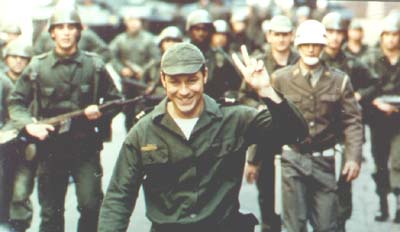
Without looking up from his newspaper, my father answers, "Certainly, the officers stopped at traffic lights. As it should be. Order and discipline." Finally, he puts the paper down. "It was a matter of public safety. You have to respect the laws."
MORE FUNNY: Shortly before some Captains of April were scheduled to take over the government radio station, they locked themselves out of their car. At the time, they were parked, unbeknownst to them, in the most notorious homosexual meeting place in Lisbon. And the young men have to change into their uniforms inside the car. Well.... funniness ensues.
For my info re: My family & the Portuguese Revolution, SEE: Flying to America: Revolution & its Discontents
Flying to America:
REVOLUTION & its Discontents

I left Portugal nine days after junior officers led a coup against the semi-fascist regime that had dominated Portugal for decades.
My parents planned to work in America for two years, and save enough to mechanize the Vazao stone-cutting business. Then we would return to Portugal.
But then, the Carnation Revolution happened. And political & economic instability ensued. Thousands of refugees from the Portuguese colonies in Africa flooded into Portugal. Many had lost fortunes, and couldn't find jobs. People were desperate, and running out of patience. They wanted government assistance, and they wanted it NOW. My parents feared a Communist takeover.
My dad had initially supported the revolution, but I hadn't known that as a child. Both my parents seemed arch-conservative to me. Mostly, my mother ranted re: communists & my father said nothing, so I assumed he agreed. Yes, I was naive. But then, I was only four.
By 1976 (two years after the 25 de Abril Revolution), the Communists had gained substantial power among the ruling factions. Local communists (including some distant kin) had led the resistance in Portugal, as local communists had led the resistance against fascism in most countries in Europe. After decades, the Portuguese communists had become disciplined and well-organized compared to centrist and left-of-center factions. In the southern provinces, a few large estates had been invaded by landless peasants & Communist allies. Led by their bishops, Catholic priests preached the imminent threat of a Communist takeover.

Communist-led unions organized strikes, but much of the violence was spontaneous. The poor had been repressed for decades, and many acted recklessly. As my father said, "What does an abused and caged dog do when it escapes? It bites the Master." Given the cold war climate, my parents were terrified.
SEE: NYT Film Review re: Documentary: Scenes from the Class Struggle in Portugal (1977)
My mother's employment visa to America was sponsored by the Honeywell Corp, or some such. She was a tailor & embroidery teacher, who started her own school. More importantly, she designed wedding dresses and other custom-made garments [see: photo of one of her creations]. We were supposed to settle in Philadelphia.
Instead, we remained in Ossining where my mother had one cousin who had emigrated from Portugal to Brazil, and from Rio to the US. More important, her second cousin also lived there and was available to pick us up at Kennedy airport.
Yes, we have cousins in many cool places, including Paris & Madrid, and, at one time, Mozambique & Angola. The Portuguese are a mobile, swift-footed people. You never know what tomorrow holds. You may have to leave in the middle of the night. Literally, as did our cousins in Angola.
[To be Cont'd]
Want to see a film re: Carnation Revolution? CLICK: A funny thing happened on the way to the Revolution, re: Capitaes de Abril, or Captains of April (available on Netflix!)
STAY TUNED: I made a 10-minute video with still pictures & audio entitled, "Maria Vazao Wills a Miracle" for Oral History class @ Sarah Lawrence. Pictures will be posted. And perhaps audio too.
Poetry: Fountain of Youth

I write poetry because I need poems to vitalize everyday life, and not because I am a professional and/or "working" poet. I don't write every day. I should, but I don't. I'm a lover, alas. I'm not married to the Muse.
Perhaps, it's fear of commitment. Sometimes I go weeks w/o composing. But every single day, I envision poetry mentally & take out my five senses. Sometimes I experience a mental poem as vividly as I experience a film. A scene. Dialogue strings. A fight and/or flight. An image. A metaphor growing like a tree, with petals hue-ing & falling.
And daily, I play with words. We go running, words and I. Sometimes we take off, and fly too close to the sun. Call me spacey. Astronauts do it with more thrust.
Seriously, I don't desire publication, at this time. I have no desire to publish the Great America [fill in -------] at any point in my life. I've published exactly one poem. Which is one more than the number of stories or essays I have published. Unless you count the series of short stories I wrote for a student-organized tabloid at St. Augustine's Elementary School. That is, until we got busted for publishing w/o school authorization, and, audacious!, charging students for it, and best of all, making money :) Samizdat for the middle school set.
I want people to hear and be influenced by my poetry, and that objective won't be achieved by publishing in journals that few poets read, let alone the general public. My project is poetry performance, and getting grants to work on larger projects & craft, so that one day I will publish something meaningful. Something that spurs folks to do, to be, to vitalize their lives.
For now, I write lyrics, modern-day ballads, and psalms. Some are borderline erotic (ok, maybe I've crossed the border). Some are metaphysical, or otherwise philosophical. But all are passionate, that is embodied. Gut-sy. Incarnate or Carnal, depending on your point of view, or preferred organ of sensation. Whatever. I write what I write. What you do with my words. Well, that's up to you, isn't it?
****
Category: Psalm
Lord,
Show me mercy. I'm just
Human. Breathe me.
Break my blood-brain
Barriers. Commit me.
With your extravagant passion,
Fire me.
Clinging to Eden:
Converso Names Take Root
If you want a sense of how meticulous Lusos (people of Portuguese heritage) can be when it comes to documenting death and torture, watch the movie Brazil. Speaking of Death, I'll also need to examine cemetery stones in all towns where kin are known to be buried. Fortunately, I think cemeteries are kind of cool. Taratara, taratara, taratara... Btw, I reported for Court TV, and gallows humor is an occupational hazard.
Complications Ensue...
Most of my family, myself included, don't have birth certificates. My only record of "coming into existence" is my baptismal record, or cedula (which doesn't have a picture). The cedula records birth, confirmation, marriage, and other sacramental rites. The parish also kept records of "good behavior" & financial conributions. And course, records of heretics, and their "outcome."
But, until I can get grant money for travel, I must rely on Library & Web research; exploration of every clue, however far-fetched; lots of Imagination; and Conspiracy-Theory-type thinking.
Likely, I'll dedicate a wall in my apartment to creating the kind of Five Families chart & photo/evidence display you see in FBI movies, or in my favorite serial-killer series, DEXTER. Imagine: a massive map with green-circle push pins & flags. I'll post dork-wall-pics as I progress.
Confirmation BIAS alert: Even though I want to believe my immediate ancestors' surnames are definitive clues, they are about as reliable as hearsay, however juicy my "facts" may be. Pre-modern people made up & discarded surnames at will, and often village folk re-named their neighbors. Descriptive names might stick to a man, and remained glued, like it or not, to the next generation. Imagine a world where nicknames given by siblings, fraternity brothers, the town joker, and/or gossips outlive you and afflict the next few generations.

[RIGHT: Pinto Horse & my grandfather's namesake. Francisco Pinto was quite a horseman & served in the Portuguese Cavalry. Perhaps a name does bring on a Destiny: Wikicommons]
My maternal grandfather, Francisco Pinto, for example, loathed one of his paternal surnames: Alpiarca. It was the name of the village in central Portugal from where his grandfather migrated. When he was nine or so years of age, Francisco Pinto managed to officially eliminate the Alpiarca name from his line of descent. My people are precocious. He wasn't the only anti-Alpiarca campaigner; many kinsmen tried to wipe the name from history. Of course, that/those stories are for another post. And of course, the name survives (in Massachusetts, btw).
A man and/or woman could try to assert control over their destiny and/or re-create their heritage by adopting the name(s) of persons they aspired to be. Or take the socially-respected, Inquisition-Evading names of the local gentry. A powerful patron could be named as a child's godparent, and the godparent's name (and some privileges) would be given to the child.
A great source is Jeffrey S. Malka, author of Sephardic Genealogy: Second Edition, Discovering Your Sephardic Ancestors and Their World. [More commentary from Malka in future posts]
Why are Portuguese named after so many TREES??
To briefly sum up: When forced to convert, Sephardic Portuguese chose new surnames that were "close to the earth."
Commonly, when Jews were baptized, they re-created themselves by selecting names of trees, eg, Carvalho (Oak), Oliveira (Olive tree), Pereira (Pear tree), Pinheiro (Pine). Less common: fruit, eg, Sousa (type of Sherry grape near the Douro River); or animals, eg, Coelho (rabbit), as in Tony Coelho, former congressman, and Pinto (type of horse), which happens to be my grandfather's name.
BOOK SPOTLIGHT: All-of-a-Kind of Family series
I'd always "known" --gut/intuition-- that I'd somehow been "misplaced" in my strict/medieval Catholic uber-practical-anti-intellectual family. There was NO one even remotely like me among my relatives (or so I thought). I was a solitary dreamy/spacey kid who read "too many books," according to my mother. She worried about the effects of reading on my mental heath, and of course, on the sanctity my soul. She'd tell me to stop reading & go watch television to "rest" my head. Seriously.
Often, she confiscated my library books for review. Bizarro world. I remember once slipping books under the floor-boards of my bed. But my mom would go into my room, "just to clean up," and search under the bed. (I had a bit of fun with this habit when I became an adolescent).
I was a library hound & didn't much care that other kids considered me a dork. I was an arrogant little F---. At the Ossining & Briarcliff Public Libraries, I located all the books in the series.
I identified w/ the four daughters (in an Orthodox family of 5 children) & longed for their close-knit community life. And mostly, I loved traveling back in time to a world radically different from my own. The truth WAS stranger than fiction. No surprise that I became a writer of narrative nonfiction.

Image from Amazon.com